
Escambia County Sex Offender Checks
ALEA Criminal Justice Information Services maintains the Alabama Law Enforcement Agency Sex Offender Registry and Community Information Center. Local sheriffs and police register and verify people in their jurisdictions, then forward changes, photos, and fingerprints. ALEA says the public registry updates daily in real time from those local submissions. For Escambia County, the state registry is the main public search. The sheriff's official app also advertises sex-offender access as a mobile route.
Not every sex-offense conviction appears. Alabama Code §15-20A-5 defines qualifying offenses, while the public system has exclusions and conditions for some juveniles, youthful offenders, first convictions for sexual misconduct or indecent exposure, and certain out-of-state, federal, military, or tribal convictions that require due process. A missing profile cannot be read as proof that no conviction exists.
Escambia County Registry Gateway
The ALEA Community Information Center is the official state gateway for registry and related community-information services.
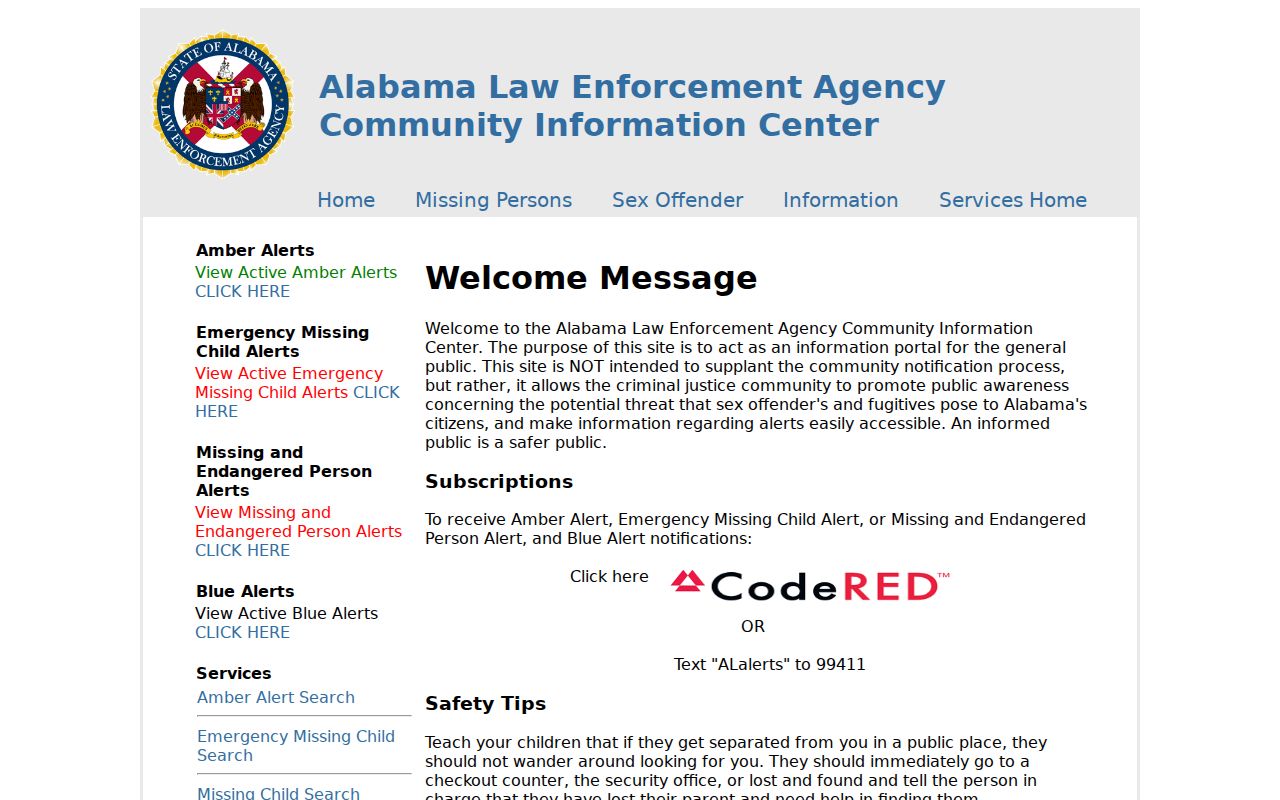
The gateway places an Escambia County registry search inside the statewide system rather than presenting a separate county database.
Use the county filter for a broad local review, or begin with a name or address when the question is narrower. Map geocoding can affect address results. Name variations and aliases also matter. Compare the legal name, aliases, photo, physical description, and registered location before concluding that a result is the intended person.
ALEA Registry Searches
The ALEA registry offers name and location paths, a county selector, and map or list views. Search and Reset controls submit or clear the query. Exact labels and map options can change with the vendor interface, so use the controls shown at the time of search. The county-wide route is to choose Escambia in the county dropdown, then inspect the result list and each relevant profile.
- Open the ALEA Community Information Center and review its conditions of use.
- Choose a name search or location search, or select Escambia for a county-wide view.
- Compare the map or list results with known identifiers and aliases.
- Open the full profile and read the offense, status, registering agency, address, and update fields together.
| Field Label | Type | Required | Notes |
|---|---|---|---|
| Name search | Text | Path choice | First and last name route; exact requirement not stated |
| Location or address | Text/map | Path choice | Street, city, or ZIP; geocoding affects matches |
| County | Dropdown | No | Select Escambia for a county-wide review |
| Map or list | View control | No | Switch between geographic and list results |
| Search or Reset | Buttons | Yes to act | Submit or clear the current query |
A county-wide result is a starting set, not proof about every person or address. Open the current official profile and compare all displayed identifiers before relying on a match.
Escambia County Registry Updates
Daily real-time publication still depends on local reporting. A registered person gives required information to the sheriff or municipal police for the place of registration. Local staff verify it and transmit changes. An old address can therefore signal noncompliance, not simply a slow website. Suspected address errors or violations should be reported to local law enforcement rather than corrected through private contact.
The ALEA registry FAQ describes update timing, public-listing limits, and the state registry contact.
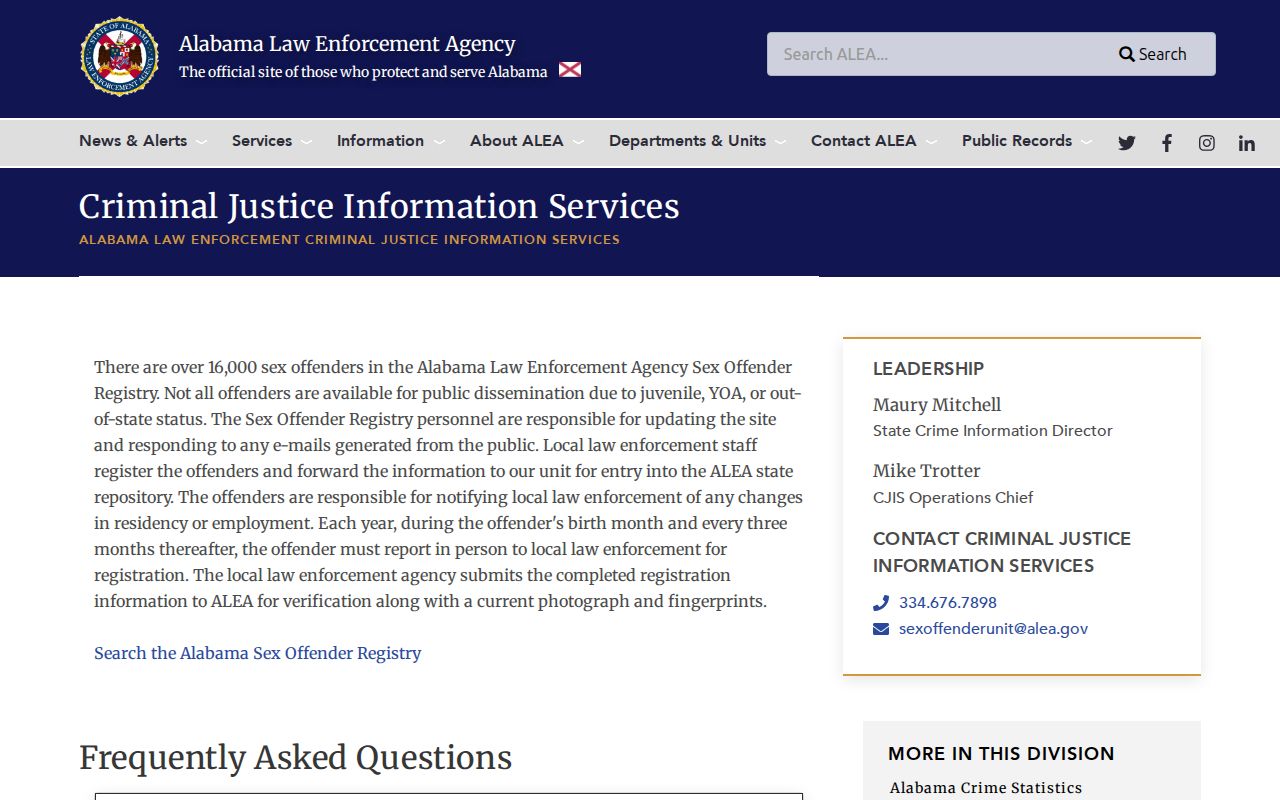
The FAQ helps explain why release status, qualifying law, and local submissions all affect when an Escambia County profile appears.
ALEA's registry unit can be reached at 334-676-7898 or sexoffenderunit@alea.gov. The Escambia County Sheriff's Office uses 251-809-0741, and a municipal police department may be the local contact when the registered location lies inside a city. The official ECSO site confirms the county route, while the sheriff contact page supplies office channels. The Escambia County AL Sheriff app listing advertises sex-offender access, but the app is a shortcut rather than a distinct registry database.
Registry Profiles: What They Show
A public Escambia County profile can identify the person and show the facts Alabama authorizes for community notice. Read status and last-update data with the address and registering agency. Do not infer private facts from blank fields. Alabama's backend collection is broader than the public display, and a field held by ALEA is not automatically public.
| Name & Aliases | Current legal or display name and listed aliases. |
|---|---|
| Photo & Physical Description | Photograph, sex, race, age or birth data, height, weight, hair, eyes, and identifying marks when shown. |
| Registered Address | Residence and map, plus other authorized school or work locations. |
| Offense & Statute | Qualifying conviction description, statute, date, and jurisdiction. |
| Vehicles | Publicly authorized vehicle and plate information. |
| Registration Status | Compliance or absconded status, registering agency, and last update or verification. |
The profile should be read as a set. A photo or similar name alone is not enough for a sound match. Address, alias, registering agency, conviction jurisdiction, status, and last verification help distinguish the intended record while staying within the public fields Alabama authorizes.
Escambia County Registry Data Limits
Alabama Code §15-20A-8 may allow public display of names and aliases, each residence, school and employer addresses, some transient or day-labor information, vehicles and plates, photograph, physical description, qualifying conviction history, and compliance or absconded status. It excludes nonconviction arrests, Social Security numbers, passport and immigration or travel numbers, victim identity, online identifiers, and internet-service-provider information.
Those limits protect both accuracy and victims. A registry profile is not a full court file, arrest history, or private investigative dossier. To understand the judgment behind a listed offense, use the correct court record without copying a registrant's personal values into another publication. Community awareness works best when the official profile remains the source.
Registration Levels and Duties in Alabama
Alabama is not presented to the public as a simple adult Tier I, II, and III system with ten-year, twenty-five-year, and lifetime rows. Adult duties under ASORCNA are generally lifetime, subject to limited statutory relief. ALEA states that in-person verification occurs during the birth month and every three months after that. Juvenile rules differ and must not be used to label adult profiles.
| Alabama category | Duration | Verification model |
|---|---|---|
| Adults under ASORCNA | Generally lifetime, with limited statutory relief | Birth month and every three months thereafter |
| Specified serious juvenile adjudications at age 14+ | May be lifetime, with possible petition after 25 years from release | Controlled by juvenile risk procedures and court orders |
| Other qualifying juvenile registration | Generally ten years | Public notice depends on juvenile risk classification |
Registration and change rules generally require in-person reporting within three business days under current acknowledgments. Alabama Code §§15-20A-1 and following control exceptions and relief. Exact duties depend on the person's legal category and order, not a label invented from another state's tier system.
The juvenile model needs separate care. Specified serious adjudications at age fourteen or older may carry lifetime registration, with a possible petition after twenty-five years from release. Other qualifying juvenile registration generally lasts ten years, and public notification depends on a risk classification process. Those juvenile risk labels should never be transferred to an adult Escambia County profile. For adults, the public should rely on the duties and status shown by Alabama's official system and the governing order.
Escambia County Registry Residence Duties
Alabama Code §15-20A-11 generally measures 2,000 feet from property lines of specified schools, childcare facilities, resident camps, and certain victim-related locations for adult residence rules. ALEA also notes a 500-foot loitering restriction in a specific minor-victim setting. These rules have definitions and exceptions, so a map pin alone cannot decide whether one address complies.
The safer course is to report a suspected violation to the registering agency. Do not confront the person or make a private legal judgment from map distance. Local law enforcement can compare the actual property lines, facility type, victim-related conditions, registration acknowledgments, and governing statute.
Escambia County Registry and NSOPW
ALEA is the primary Alabama source. The U.S. Department of Justice National Sex Offender Public Website adds a cross-state layer for searches that may involve more than one jurisdiction.
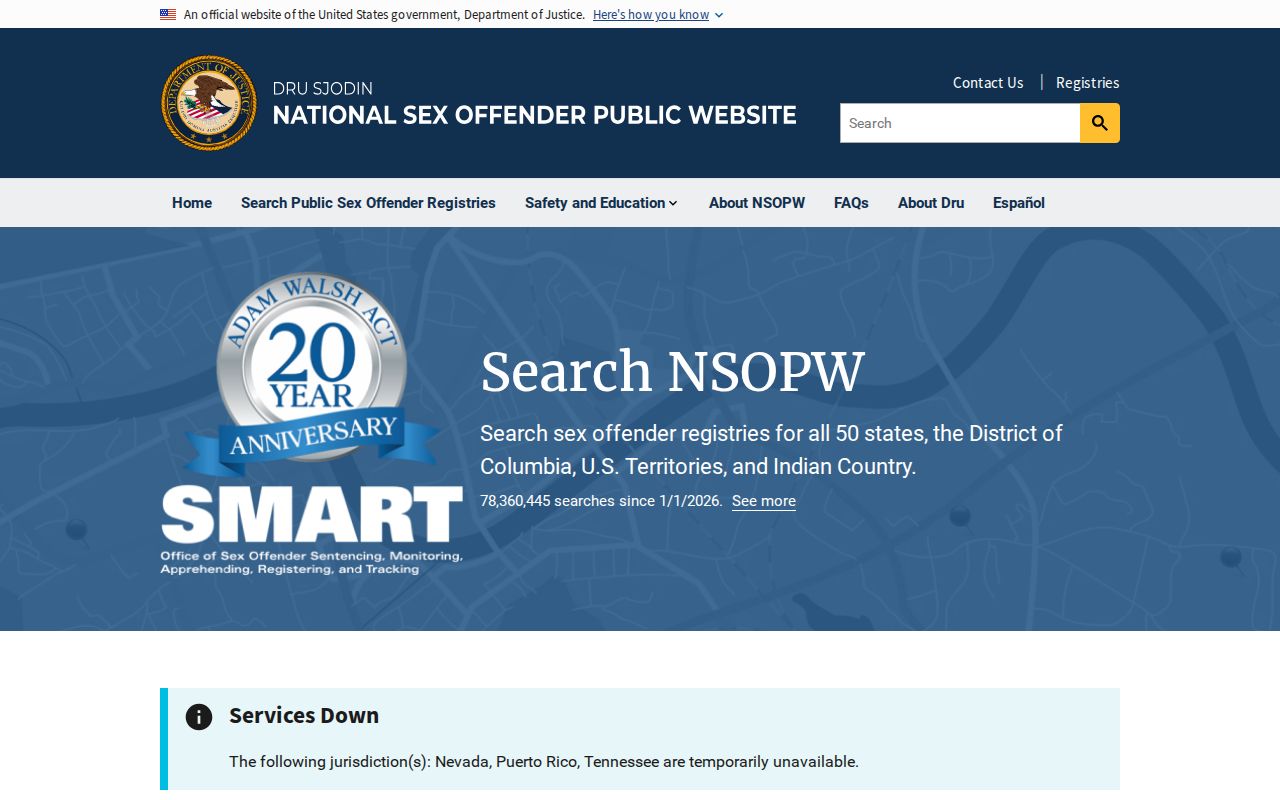
NSOPW is useful for a national cross-check, while ALEA and Escambia County law enforcement remain the sources for Alabama profile detail and local compliance questions.
The two systems should be compared, not treated as duplicate proof. Reporting timing, jurisdiction participation, name formats, and location data may differ. When an Escambia County result looks wrong, save the official source details and contact the local registering agency or ALEA registry unit.
Using Registry Information Lawfully
Public registry data supports personal safety, family planning, and community awareness. The web search does not replace community notification or local verification. Use the profile to understand the official notice and to decide whether a concern should be reported. Never use it to threaten, harass, intimidate, or take enforcement into private hands.
Use the registry lawfully: Alabama registry warnings and §15-20A-8 forbid misuse. Report suspected violations to law enforcement and do not harass, threaten, intimidate, or commit a crime with registry information.
Community notification can contain facts beyond what a casual map glance conveys, while the official profile still has set public limits. If an address appears stale, contact ECSO, the relevant municipal police department, or ALEA. That response protects public safety and preserves a lawful process.
Keep a note of the official profile date and registering agency when reporting a concern. Clear source details help the responsible Escambia County office check the record without exposing more personal data.